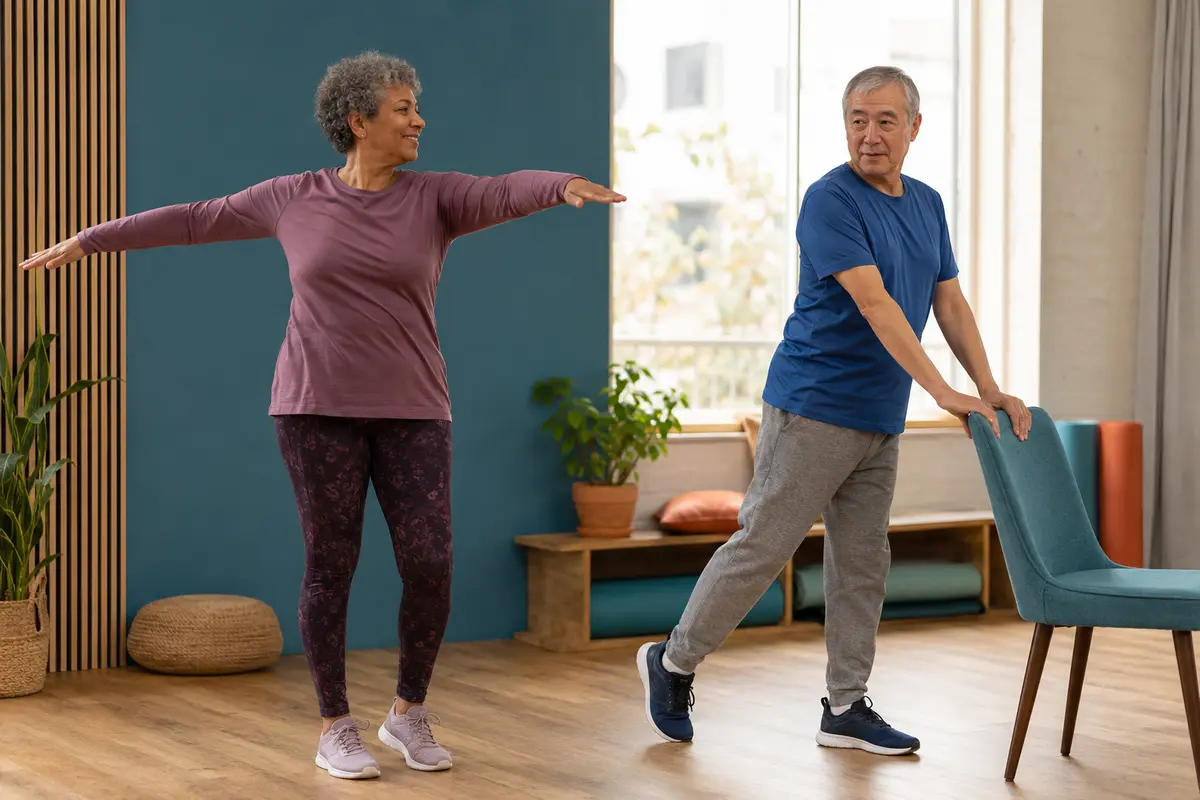
If your knees pop when you stand up, your hips feel locked after sitting for an hour, or your shoulders ache on the first overhead press, your body may need a more specific warm-up. A standard treadmill walk does not prepare every joint for every movement.
The Assess–Activate–Move (AAM) Check is a three-step framework adapted from common warm-up principles. It takes about eight minutes and changes based on what your body needs that day.
Step 1—Assess (2 Minutes)
Stand and do one slow, deliberate bodyweight squat. Note where you feel tightness or resistance—not sharp pain. Rotate each shoulder backward in a full, slow circle, then turn your head gently from side to side.
This check helps identify which joints feel stiff today. That answer can change from one day to the next, which is why the same fixed warm-up may not always fit.
Step 2—Activate (4 Minutes)
Target what you noticed in Step 1. Tight hips? Try slow hip circles and a gentle hip-flexor movement. Stiff shoulders? Try band pull-aparts or controlled arm circles. A stiff lower back? Cat-cow movements may feel appropriate.
Move slowly and intentionally. If you manage arthritis, recent injury, or persistent pain, ask your physician or physical therapist which movements and ranges are appropriate for you.
Step 3—Move (2 Minutes)
Use a dynamic movement that resembles the workout ahead. Before a strength session, rehearse bodyweight squats or an unloaded hip hinge. Before cardio, march in place with comfortable knee lifts and arm swings.
The goal is to prepare the tissues and movement patterns you are about to use.
Why This Can Work Better Than a Generic Warm-Up
A general cardio warm-up raises body temperature, but it may not prepare the specific joint ranges required by your workout. The AAM Check adds deliberate, multi-directional movement and rehearsal.
Progressive strength training can still work after 50. The key is appropriate load management, good technique, enough recovery, and a willingness to adjust based on how your body responds.
Try the AAM Check before your next session. Notice which area speaks first—hips, shoulders, knees, or lower back—and use that information to train more thoughtfully.